
Expression Emerges
Through Lens and Life

I’ve touched recently on some fairly sensitive details about my life and my recollection of childhood as an obscure artist’s daughter.
Even in my latest piece, which was meant to focus solely on my father’s cataloged paintings, personal memory surfaced.
I suppose that is what occurs with stream-of-consciousness writing rather than drafting or brainstorming beforehand.
As far as my father’s full and nearly countless body of art… I could travel down a hundred different avenues to share images and discussion, exponentially so—when it comes to the drawings and other works besides the completed and cataloged oil paintings in his series Distinguished People and Historic events.
My father’s artistic range is something I feel both awe and challenge in conveying properly here. His depth is something I aim to honor as I share his story.
Intuitively, though, I can see some other themes need to come through before I continue—or they will inherently insist on surfacing in places where I am really only meaning to lean heavily into the art, itself.
When Art and Life Converge: Hidden Layers of Memory and Meaning
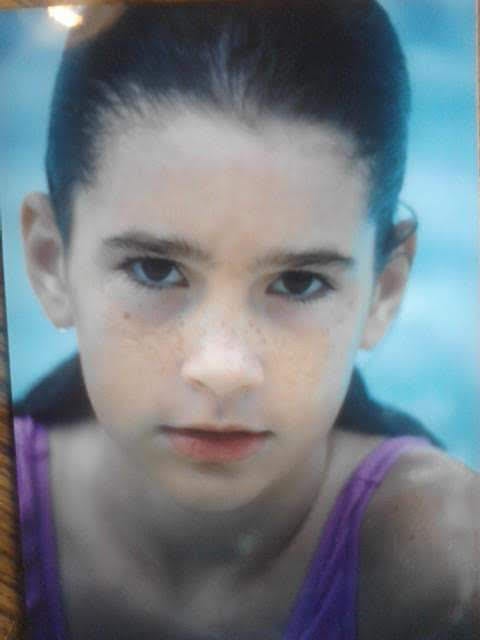
The picture, above, is one of myself around age 8, maybe 9 or even 10. We had moved back to Orlando—the east side of the city rather than the west that we had transferred away from for two years to Charlotte—and our house was new construction. By the time this picture was taken my mother had financed installing a screened-in pool and a deck with the area of our back yard.
As I think on it now, it seems an absolute luxury to have enjoyed a pool as part of our home as a middle-class one-income family of three in comparison present-day. We no longer have that home or property. Both my mother and I live in rentals. I dream of at least having a plot of land someday, but for now in the landscape of today… I find more joy not trying running my vitality into the ground trying to stay afloat financially as it is.
Growing up as an only child, that pool was a wonderful hobby for me. I would swim alone, or with my childhood friend Amanda who passed away when we were 16. We would have fun trying to synchronize our swimming moves, pretend to me mermaids for a hot summer day, or just jump and splash for the sensory input.
When I was alone the water was a calming way to center, to ground, to innately process life and my passing days before cell phones or pagers existed.
Sometimes my father would get in when I was not using the pool and swim voracious laps for exercise back and forth, back and forth. I learned how to swim by watching him, same as I did for ice skating.
Aside from from occasional early morning swims, he spent all of his time in his art studio, unless he was making his lunch or had taken a coffee break, or maybe decided to watch a bit of Star Wars in the living room, stimming with a bag of Lays chips or a piece of gum—probably contemplating his next process for the picture on his easel all the while.
Given all of that, he was immersed in his own world. He did have a studio table in front of a window that gave a scant view of the far edge of our pool deck, but I know for certain by distinct indication he was, every moment, completely engrossed in his work.
It had been what felt like years since he had given me his real, most complete and undivided attention in the way of looking at my face for any length of time (as a father would, connecting meaningfully with his daughter).
Sure, there were the times he brought me along on the golf course and kept me in the golf cart so he could play a good 18 holes around the age of 6.
There was the time when I was very young, maybe 3 or 4 years old when my parents took me to Circus World. I remember being unsure about having my face painted like a clown… but since my Dad had it done and seemed to love it, I swung for it. Ironically for what it was, I remember it to be one of the more authentic bonding memories between my father and I.
I remember coming home from our family outing to Circus World, feeling like I never wanted that moment with him to end. I threw a fit when it was time to remove my face paint, desperate to hold onto the experience just a little longer. I held steady my figurative line drawn in the sand about not wanting to take off that face paint, sitting on my front porch with my chin in my hands, still wearing thick, colored yarn tied into my hair.
There was the time, also, my father was put up to take me to the miniature golf course… a place that had steep, unfinished wooden stairs. I was wearing jellies on my feet, running up the steps to keep up with him, and in doing so I sustained a pretty intense injury to my big toe, bleeding profusely. I remember his adamancy about finishing the round we paid for before returning home. Needless to say, there was an absence of connection on an emotional level, there.
However, now… I do not believe that his emotional distance was completely intentional… that difficulty to relate, to fully empathize, to connect either in simple or significant ways… human to human, father to child.
The image above… It was one day only and I do not remember it cognitively. Only the capture, itself, is evidence that this short photo shoot occurred at all—so this was not common. In fact, it might’ve been the first time he aimed the camera directly at my face that particular way, ever, especially at that maturing age.
I do remember him posing me years before for a portrait with a back drop on a small stool—like a school would—in our home studio in North Carolina. However, to my recollection, that photo of me in our pool in Orlando might’ve been the first time in several years I noticed in the moment… I had my father’s complete and undivided attention… from behind his camera.
I was curious at this. And also the cumulative effect of such emotional distance seemed to bubble to the surface for that capture, as well.
And so, you might notice a natural, emerging expression on my face as a result. This natural reaction came from seeing my father focus on me, something rare amidst his usual photography subjects.
I do not belief there was much direction given by him for any sort of post. I do not know what inspired him to capture my face that day. In looking at the image and taking into account my lived experience with and around my artist father… I feel the result is timeless. Almost a sullen kind of magic.
I am able to interpret the expression in several ways, because it is me.
Unmasking the Past: A Photograph, Hidden Emotions, and the Realization of Neurodivergence
Perhaps it was inadvertent… But I see that photographic capture as the result of an inadvertent personal-social childhood “experiment.” It wasn’t purposeful or my intended design, but regardless there was a certain kind of childhood rage underneath of that curious face that day.
I have mentioned before how it is my belief my father was undiagnosed autistic. I can easily identify this with knowledge I have now, present day. We would never have known of such a term in those years—or before—especially since my father was able to mask to a certain capacity. Add alcohol to the picture, however, at some social function having to do with my mother’s job… and all bets were off.
When he unmasked at home it was a stark change to that of how he made himself able to get along in the world when he absolutely had to—or wanted to. William Mix did have his artwork in a gallery at the Mercado in Orlando, but it didn’t last long.
At home one of the phrases he would randomly say any given day was, “I just gotta be me.” It is hardly a wonder to me now just how his reclusivity began.
I have a lifetime of observations about his behaviors in life that have only led me to this theory of an unrealized level of autism. Coming up on just one year ago, part of understanding this about my father was realizing my own neurodivergence first. Suddenly, my entire life began to make sense.
Seeing the Spectrum: My Father, Myself, and an Unexpected Reflection on Screen
I would like to share a clip from a movie. I am no psychologist, but I am aware there are different levels of autism having to do with low to high support needs. However, the different traits of autism can be expressed and manifest, of course, on a vast spectrum. Traits of autism vary and present differently for each individual who might succinctly fit the necessary criteria for a diagnosis by a professional.
That being stated… This movie I Am Sam with Sean Penn, Dakota Fanning, and Michelle Pfeiffer truly hit me hard when I saw it years ago. At the time, I didn’t know why.
As I share this clip, please know that my father did not have intellectual hindrances as it seems to be expressed in Sean Penn’s representation of Sam, the main character of the movie. I am not intending to infer that my experience of my father was exactly like what you may notice about Penn’s portrayal.
However, there are many ways that my father would behave—in public and socially, especially—that always struck a chord with me in my youth and left me knowing in such a loud way my father was different than other fathers. Admittedly, the chord struck was one of shame when it would have served us both much better had it been a chord of empathy, instead.
In this movie Dakota Fanning’s character did not have distinct judgmental influence about her father’s affect or presenting condition as she was placed in foster care after her biological mother abandoned her as an infant.
Watching this clip… It brings me healing.
As I have mentioned before and in my last post concerning the sense of rejection I received from my father as he dove always into art… I cannot present my perception of our story in a way that omits the fact of how, even early in my childhood… I learned to reject his behaviors—and eventually, reject him, entirely—even while sharing the same living space all throughout my youth.
I had a distinct hand and responsibility in the strain of our relationship, also—even unbeknownst to me at a young age.
If I could do my youth over, again… I would absolutely have treated my father with love, with care, with understanding, with non-judgment. Instead… for example: I was so involved with feeling hurt as a teenager I even assumed his chewing gum loudly in the living room was purposefully so that I would leave the room—and I always did.
Now I understand he was stimming, something autistic individuals do commonly in order to self-regulate…. These behaviors are hard to suppress. His stimming intensely agitated the high sensitivities of my own neurodivergent qualities.
Now I know, so many years later. However, our interactions, non-interactions, relationship or strain of one… It was all exactly how it needed to be for our souls each to learn and grow while here in these very particular lives, during this very particular time on earth, in our very distinct lineage, ancestry, and with our shared DNA.
It was supposed to have unfolded in just this way to deliver me to the keyboard, even now, to yet again find writing as therapy.
So… the interaction you might see and notice in the clip, above… This is what I would have wanted for us in a more “perfect world.” Even though my father would probably not have been able to connect so emotionally and sentimentally with his child as you see here… This really, really hits home. I feel it, deep.
Life is so much of a ceremony. Much of our experience may not make sense for years to come, but when it does… Transformation is not only a viable possibility, but the alchemy of transformation has already long-since begun to work in our lives.
I wanted to share this vulnerable story and these sensitive reflections for you tonight, well after midnight as I finish this installment. I share this because I deeply appreciate your presence here.
Thank you for reading.
Until next time,
All the Love,
Colleen Noelle